 Path
November 2026
The client says the site was down all weekend: how to prove what happened
Monday morning, the client says the site was down for two days. Without a dated record, it is their word against yours. What to keep on file.
The message lands first thing on Monday. The client heard from a buyer, or saw an error page themselves on Saturday evening. To them, the site was down “all weekend”. The agency saw nothing. It has no start time, no end time and no idea which page was affected. The conversation then drifts to this month’s invoice and to trust. It is settled with dated facts, or it is not settled at all.
What you need to be able to show
- The time of the first failed check, and the time things went back to normal.
- What was affected: the whole site, one page, or a single step of the purchase journey.
- What the visitor saw: the response code, or the screenshot at the step that broke.
- Who was notified, at what time, and through which channel.
- What the agency did, and when: the intervention note, written the same day.
Three situations, three answers
- The site did go down: you give the exact duration, the cause and what was fixed. A measured duration is almost always shorter than “all weekend”.
- The site was answering, but one step was broken: the client is right on the substance. Only a journey check shows it, not an availability check.
- Nothing broke on the site side: the record shows it, and the search moves to the buyer’s network or device.
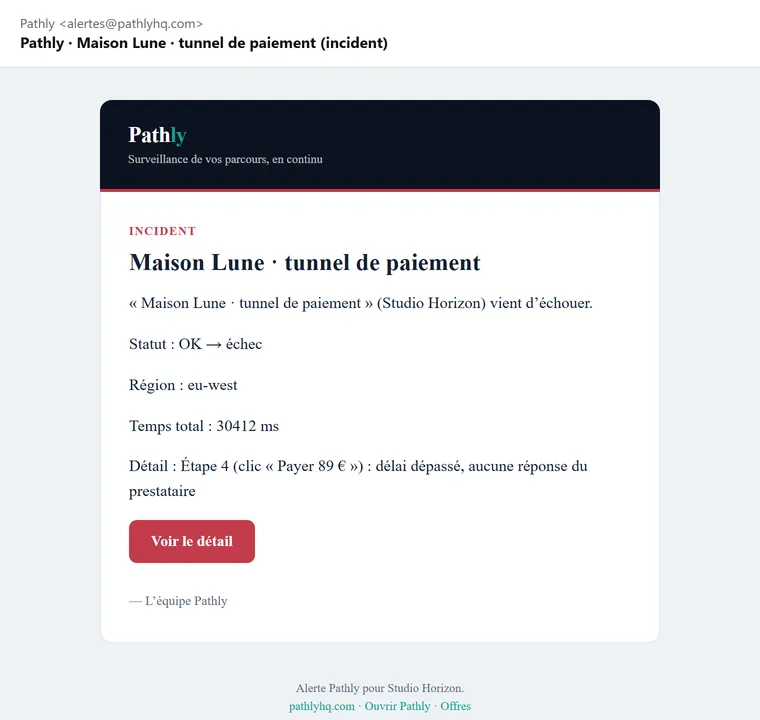
What Pathly keeps for you
Every Ping and every Flow leaves a dated trace: pass or fail, response time, step at fault. A Flow that breaks keeps the screenshot at the step concerned. The incident has a start time and an end time. The intervention log takes your note, and the monthly report brings it all together. The history stays available for the period set by your plan. Pathly does not say what one particular buyer saw at home: it says what the site was answering, from our probes, at the time shown.
- Aren’t the host’s logs enough?
- They say what the server received. They do not say that a button had stopped responding in the browser. And they are not always kept for long.
- Should the record be sent to the client after every incident?
- A short message the same day is enough: start, end, cause, fix. The detail waits in the monthly report.
- What if the contract provides for no monitoring?
- This is the time to write it down: what is monitored, how often, and who is notified. A clear clause avoids the same conversation next month.